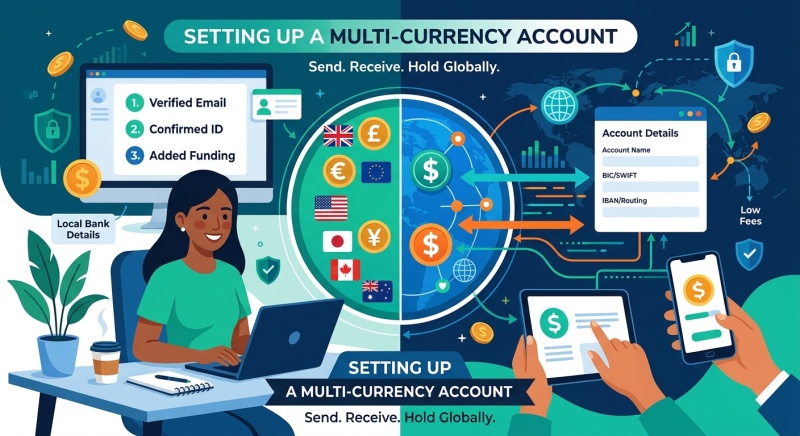
Setting up a multi currency account feels like one of those grown-up finance moves. It's the moment you finally crossed into the land of people who “optimize” things. Maybe you…
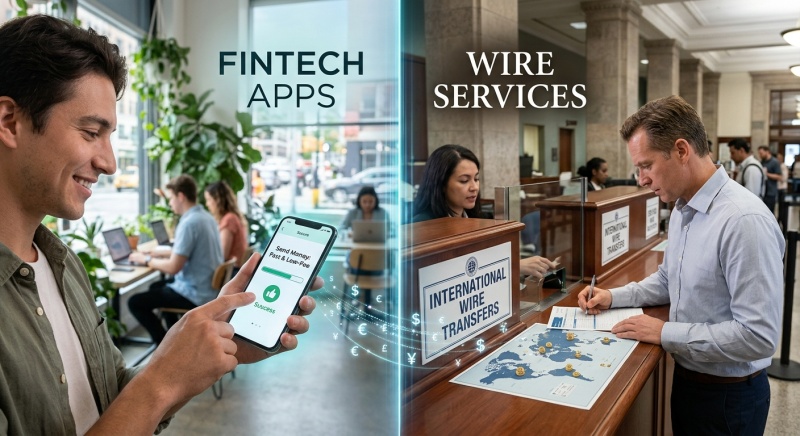
A couple years ago, if someone said, “Just wire it,” you knew what that meant. Bank branch vibes. Forms. Fees that feel oddly personal. And then that little anxious waiting…
Money transfers sound simple. You send, they receive, done. Except it is never just that. Somewhere between your bank app, the exchange rate, the “processing” screen, and the final deposit,…
Sending money across borders used to feel like a small project.
You go to your bank, fill out a form you do not fully understand, pay a fee that seems… kind of random, and then wait. And wait. Sometimes it lands in a day, sometimes it takes a week, and sometimes the recipient gets less than expected because of some intermediate bank fee nobody warned you about.
Now it’s better. Not perfect. But better.
There are more ways to move money globally than ever, and the “best” method depends on what you care about most. Speed, fees, exchange rates, reliability, cash pickup, business paperwork, all of it.
So let’s break it down like a normal person would. What are the main ways to transfer money internationally, what they’re good at, what they’re secretly bad at, and when you should pick each.
The 4 things that actually matter (before you pick anything)
Before you even choose a provider, you want to know what you are optimizing for.
Because if you only look at “fee: $0” you can still get wrecked by the exchange rate. And if you only look at “instant transfer” you might end up paying a premium.
Here are the big four.
1. Exchange rate (this is where most providers make money)
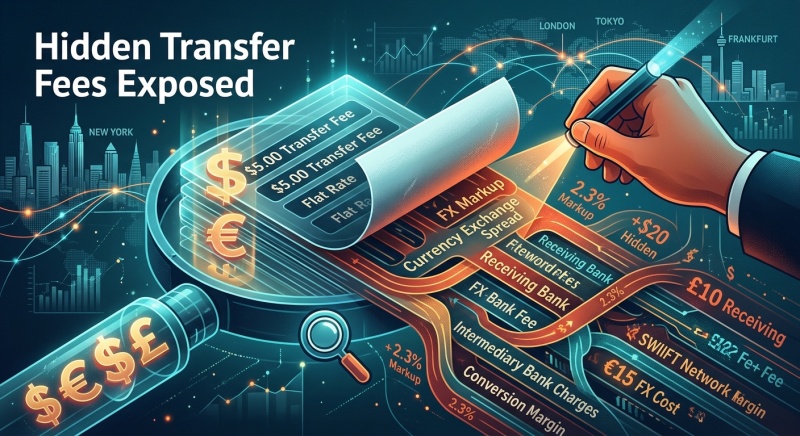
Some services charge a clear transfer fee. Others hide the cost in the exchange rate markup.
A “bad” rate can cost you way more than a flat fee.
2. Total delivery time
There is “processing time” and then there is “the recipient can actually use the money” time. Not always the same.
3. Delivery method
Bank deposit. Debit card. Mobile wallet. Cash pickup. Cheque. Crypto. Sometimes you need a specific one.
4. Compliance and proof
Businesses often need invoices, transfer receipts, the sender name to match, and clean audit trails. Freelancers sometimes need this too, if taxes are involved.
If you keep those four in mind, most decisions get clearer fast.
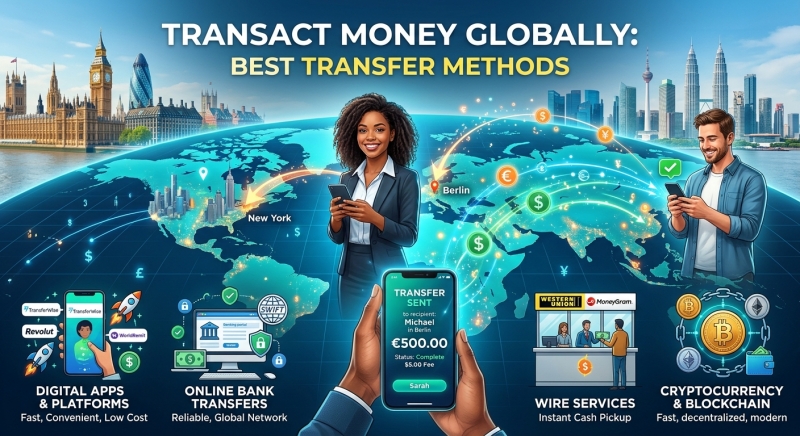
Method 1: Online money transfer services (best for most people)
If you are just trying to send money to family, pay rent abroad, move savings, or pay a contractor in another country, this category is usually the winner.
Think: Wise, Remitly, WorldRemit, OFX, Xoom, Revolut (in supported regions), etc.
They’re not all identical, but the pattern is similar.
You fund the transfer by bank transfer, debit card, or sometimes credit card. They convert your money, then deliver it to the recipient as a bank deposit or cash pickup.
Why they’re great
Often better exchange rates than banks.
You can see the fees upfront (usually).
Transfers can be fast, sometimes minutes depending on route and funding method.
Easy to track.
Where they can be annoying
Identity checks can slow down your first transfer.
Some corridors have higher fees or limited options.
Bank-funded transfers are cheaper but slower. Card-funded transfers are faster but cost more.
When to choose this method
You want a strong mix of price and convenience.
You’re sending small to medium amounts regularly.
You want transparent tracking.
A quick shortlist and what they’re generally best at
I’m not ranking these as “number 1” because it depends heavily on the country pair, but here’s the vibe.
Wise: usually strong on exchange rate transparency and bank-to-bank transfers.
Remitly: often strong for remittances, cash pickup options, and speed tiers.
WorldRemit: similar, decent coverage, cash pickup and mobile money in many countries.
OFX: often used for larger amounts and business transfers, sometimes better for big conversions.
Xoom (PayPal): convenient if you live in the PayPal world, good coverage, sometimes pricier.
If you want one practical rule: check two providers for the same route and amount, then compare the recipient gets number, not just the fee line.
Method 2: Bank wire transfers (best for large, formal transfers)
Bank wires still matter. Especially for:
paying overseas tuition
buying property abroad
moving large sums (tens of thousands and above)
corporate payments
situations where the recipient only accepts bank wires
The most common global rails are SWIFT wires. In Europe you also have SEPA for Euro transfers, which is a different thing (and usually cheaper within the SEPA zone).
Why bank wires are still useful
Widely accepted and understood.
Strong paper trail for compliance.
Good for very large transfers where app-based services may impose limits or additional checks.
The real downsides (not small)
Fees can stack: sender fee, intermediary fee, recipient fee.
Exchange rates are often worse than fintech services.
Transfers can be slow, especially across multiple correspondent banks.
It is surprisingly easy to enter details wrong.
“OUR, SHA, BEN” matters more than people realize
Some wires let you choose who pays fees:
OUR: sender pays all fees (usually best if you want recipient to get exact amount).
SHA: fees shared (common).
BEN: beneficiary pays (recipient gets less).
If you are paying a contractor or tuition bill and they require an exact amount received, OUR can save you a messy follow-up transfer.
When to choose a bank wire
You need formal documentation and maximum acceptance.
You are sending a very large amount and can tolerate slower settlement.
The recipient demands it.
Method 3: International ACH and local rails (quietly the cheapest when available)
Not every “international transfer” needs to be a SWIFT wire.
Some services route your payment through local bank networks on both ends. So instead of “one big wire”, it becomes something like:
local transfer in your country
conversion
local transfer in recipient country
This can reduce fees and speed things up.
You often get this through providers like Wise and OFX, and sometimes through bank partnerships.
Why it’s good
Often cheaper than SWIFT.
Less intermediary fee nonsense.
Can be faster, especially for common corridors.
Limitations
Not available for every currency and country.
Might not support exotic currencies or smaller banks.
When to choose it
You’re sending to common destinations and want low cost.
You’re paying invoices where predictable fees matter.
Method 4: Cash pickup transfers (best when the recipient is unbanked)
This one is still huge globally. Western Union and MoneyGram are the most famous, but many online services also offer cash pickup through partner networks.
Cash pickup is exactly what it sounds like. Recipient goes to an agent location, shows ID and the reference number, gets cash.
Where it shines
Recipient has no bank account.
Recipient needs cash immediately.
Rural areas where banking access is limited.
What to watch out for
Fees can be higher.
Exchange rates can be worse, depending on provider and corridor.
Fraud risk is higher if someone social engineers the transfer code.
When to use cash pickup
Emergencies.
Family remittances where cash is the only practical option.
Countries where banking rails are slow or unreliable.
If you care about safety, use a provider with strong tracking, do not share the reference number loosely, and make sure the recipient location is legitimate.
Method 5: Card-to-card and card payouts (fast, but usually costs more)
Some services let you send money directly to a debit card, or the recipient gets funds onto their card.
Speed is the big selling point here. The cost is… also the big feature, unfortunately.
Pros
Often very fast.
Recipient can spend immediately.
Cons
Card funding fees.
Sometimes worse exchange rates.
Card networks and issuer rules can cause weird declines.
Best use case
You need speed, and the amount is not huge.
You are okay paying extra to avoid delays.
Method 6: Mobile money transfers (massively underrated in some regions)
In many countries, “bank transfer” is not the default. Mobile money is.
Parts of Africa, South Asia, and Southeast Asia have strong mobile wallet ecosystems where receiving money into a mobile wallet is more practical than a bank account.
Some providers support direct mobile money payouts.
Pros
Convenient for recipients.
Can be fast.
Often cheaper than cash pickup.
Cons
Coverage is not universal.
Wallet limits and KYC rules vary.
Cash-out fees may apply locally.
Best use case
Sending money to regions where mobile wallets are more common than bank accounts.
Routine remittances.
Method 7: PayPal and similar wallets (convenient, but watch the math)
PayPal is everywhere. Which is the point. It’s accepted by tons of freelancers and small sellers globally.
But convenience comes with tradeoffs, mainly around exchange rates and fees.
When PayPal is great
Paying for digital services where the recipient expects PayPal.
Situations where buyer or seller protection matters.
Micro-transactions where speed and simplicity beat optimization.
When PayPal is not great
Large transfers where exchange rate markup becomes expensive.
Payments where chargeback risk is a problem (for the recipient).
Countries where withdrawing to a bank account is slow or costly.
A practical tip
If the recipient can invoice in their local currency versus yours, or vice versa, test both scenarios. Sometimes the currency choice changes the total cost a lot.
Method 8: Cryptocurrency and stablecoins (fast and global, but not always “simple”)
Yes, people do move money internationally via crypto. Especially stablecoins like USDT or USDC.
It can be fast. It can be cheap. And it can also become a mess if either side is not comfortable with it, or if local regulations make off-ramping difficult.
Pros
Cross-border speed is usually excellent.
Often low network fees (depending on chain).
No banks involved.
Cons
Regulatory uncertainty in some countries.
Recipient still needs to convert to local currency to spend (off-ramp).
Scams and irreversible transfers if you send to the wrong address.
Tax implications in many places.
When it actually makes sense
Both sides understand crypto well.
You are moving money to yourself between countries.
You have a reliable off-ramp on the recipient side.
You need after-hours transfers and do not want to wait for banks.
If you do this, keep it boring. Stablecoins, reputable exchanges, double check addresses, and do a small test transfer first.
So what is the best method, really?
It depends on your scenario. Here are the most common ones and what usually works best.
Scenario A: Sending money to family abroad every month
Usually best: online transfer service or mobile money payout.
If they need cash: cash pickup.
Scenario B: Paying an overseas freelancer or contractor
Usually best: online transfer service (bank deposit) or Wise style local rails.
If they insist on PayPal: PayPal, but price it in.
Scenario C: Buying property or moving a large lump sum
Usually best: bank wire or a specialist FX provider (often OFX style) with strong compliance support.
Scenario D: Emergency money needed today
Usually best: cash pickup or card payout, depending on the country.
Scenario E: Business paying international suppliers
Usually best: bank wires for formal vendors, or specialist business transfer providers if you want better FX and batch payments.
Fees: how to compare providers without getting tricked
You want one number:
How much the recipient receives, in their currency, all-in.
Not the headline fee. Not the “0% commission” marketing line. The recipient received amount.
When comparing two providers, line up:
Amount you send
Total fees charged (including card fees)
Exchange rate offered
Estimated delivery time
Any receiving fees (if disclosed)
A provider with a $0 transfer fee can still be worse than a provider charging $4.99 if the exchange rate is padded.
Exchange rates: mid-market vs marked-up (simple explanation)
The mid-market rate is basically the “real” rate you see on Google or Reuters, roughly the midpoint between buy and sell.
Many banks and payment services give you a rate that is worse than mid-market, then call it “no fee” or “bank rate”.
If a service explicitly says it uses the mid-market rate and shows a transparent fee, that is often a good sign. Not a guarantee, but a sign.
Speed: why “instant” is sometimes marketing
Even when a transfer is fast, delays happen because of:
So if timing is critical, do not send for the first time the night before you need it. Try a small test transfer earlier in the week.
Safety: avoiding scams and “oops wrong account” disasters
Most international transfer losses are not from hacked networks. They are from human mistakes and scams.
A quick checklist:
Confirm recipient details on a call, not just email or WhatsApp.
For business payments, watch for invoice fraud. Changed bank details are a classic scam.
Do a small test transfer if the amount is large.
Keep receipts and transfer confirmations.
Use providers with strong tracking and support.
Also, if a provider is pushing you to skip verification steps, that is not a feature. That is a risk.
Limits and verification: what to expect
Many services will let you send small amounts with minimal friction, then require verification once you cross certain thresholds.
Typical documents:
government ID
proof of address
source of funds (for large transfers)
business documents (for companies)
This is normal. Annoying, sure. But normal.
If you are planning to move a large amount, start the verification process early. Do not wait until the day you need the transfer done.
Picking the right method in 60 seconds (a simple decision tree)
If you want a quick way to decide:
Does the recipient have a bank account and can receive local transfers?
If yes: start with an online transfer service.
Is the amount very large or do you need maximum formality?
If yes: bank wire or specialist FX provider.
Does the recipient need cash, or is banking access limited?
If yes: cash pickup or mobile money payout.
Do you need it today?
If yes: card payout or cash pickup, depending on what’s available.
Are both sides crypto-native and comfortable with it?
If yes: stablecoins can work, but only if off-ramp is easy and legal.
That’s basically it.
Common mistakes people make (so you can skip them)
Mistake 1: Choosing based on transfer fee alone
The exchange rate is often the real cost.
Mistake 2: Not matching the recipient name correctly
Some banks reject transfers if the name does not match exactly. Especially business accounts.
Mistake 3: Sending a huge amount on a brand new account
You will trigger checks. It might freeze for review. Start smaller, verify, then scale up.
Mistake 4: Ignoring intermediary fees on SWIFT wires
Even if your bank shows one fee, intermediate banks can take a cut.
Mistake 5: Forgetting bank holidays
International transfers do not care that you’re in a hurry. Holidays on either side can slow everything down.
A quick wrap up
If you are trying to transact money globally, the best transfer method is usually not the fanciest one. It’s the one that matches your situation.
For most personal transfers: online money transfer services win on value and ease.
For large, formal, paperwork-heavy moves: bank wires still have a place.
For recipients without bank accounts: cash pickup and mobile money are often the most practical.
For speed at all costs: card payouts can be worth it.
For advanced users: stablecoins can be fast and efficient, but only if the off-ramp is handled.
If you tell me your sending country, receiving country, amount, and whether the recipient needs bank deposit or cash, I can narrow it down to the best 2 or 3 options for that exact route.
What are the key factors to consider before choosing an international money transfer method?
Before selecting a provider for international money transfers, consider four main factors: 1) Exchange rate, as many providers make money through exchange rate markups rather than just fees; 2) Total delivery time, including processing and when the recipient can actually use the funds; 3) Delivery method, such as bank deposit, cash pickup, or mobile wallet depending on your needs; and 4) Compliance and proof requirements, especially important for businesses and freelancers needing invoices or audit trails.
Why are online money transfer services often recommended for sending money internationally?
Online money transfer services like Wise, Remitly, WorldRemit, OFX, Xoom, and Revolut are popular because they usually offer better exchange rates than traditional banks, transparent fees upfront, fast transfers sometimes within minutes depending on funding methods and routes, and easy tracking. They work well for small to medium amounts sent regularly with a good balance of price and convenience.
What are some downsides of using online money transfer services?
Some common drawbacks include identity verification checks that can delay your first transfer, higher fees or limited options in certain country corridors, and a tradeoff between speed and cost where bank-funded transfers are cheaper but slower versus card-funded transfers which are faster but more expensive.
When should I opt for bank wire transfers over online services for international payments?
Bank wire transfers remain the best choice for large formal transactions such as paying overseas tuition, buying property abroad, moving tens of thousands of dollars or more, corporate payments, or when recipients only accept bank wires. They provide a strong paper trail for compliance but tend to have higher fees and slower processing times.
What does the ‘OUR’, ‘SHA’, and ‘BEN’ fee options mean in bank wire transfers?
‘OUR’, ‘SHA’, and ‘BEN’ refer to who pays the transfer fees in a bank wire: OUR means the sender pays all fees ensuring the recipient receives the full amount; SHA means fees are shared between sender and recipient; BEN means the beneficiary (recipient) pays all fees resulting in them receiving less. This choice affects how much money arrives at the destination.
How can I get the best value when sending money internationally?
To maximize value when transferring money abroad, compare both fees and exchange rates across multiple providers for your specific country pair and amount. Focus on how much your recipient will actually receive rather than just looking at upfront fees. Also consider delivery speed, payment methods available, and any compliance documentation you might need.